Testamentary Discretionary Trusts – Part 2

Our last blog outlined some of the major points about testamentary discretionary trusts.

This blog will address some of the other key features of a testamentary discretionary trust (TDT).

As previously discussed, two of the main benefits of a TDT are asset protection and tax minimisation. You can read more about these benefits here (link Lauren’s blog).

Some of the other benefits of a TDT include the ability to:

  • incorporate the terms of a Special Disability Trust (SDT);
  • defer capital gains tax (CGT) liability;
  • stream capital gains and franked distributions to beneficiaries; and
  • “mere expectancy” asset protection.
  1. Special Disability Trust

A TDT can be drafted to incorporate the terms of an SDT.

One of the major benefits of a SDT is that contributions by immediate family members to the trust do not impact on the mean test concessions for the beneficiary to the extend the contributions do not exceed the total amount which can be gifted to a trust (currently $500,000).  

There are also significant CGT exemptions for any asset donated to a SDT, including the main residence exemption.

If the amount to be distributed to a SDT exceeds the assets test assessment exemption (up to $694,000 indexed 1 July each year) then the balance of funds can be held by a separate TDT.

Incorporating a SDT under a TDT maximises the benefit for a disabled beneficiary. 

  1. CGT Rollover

The assets transferred to a beneficiary pursuant to a Will, will not trigger a CGT event, until the assets are sold or transferred to a third-party. This is referred to as CGT rollover.

The same CGT rollover also applies to an asset transferred to a beneficiary from the Trustee of a TDT.

This position was confirmed by the ATO in Practice Statement LA 2003/12. It states:

The cost base and reduced cost base of the asset in the hands of the beneficiary is calculated in the same way as it would have been if the asset had passed to them from the deceased’s legal personal representative.

The principal place of residence exemption under s 118-195 of the Income Tax Assessment Act 1997 may also apply to beneficiary of a TDT exercising a right of residence granted by the terms of the Will. It is imperative the Will gives each beneficiary a qualified right of residence in relation to property.

  1. Income and Streaming Powers

Provided it is not prevented in the Will, a TDT can stream capital gains and franked dividends.

This is the same as an inter vivos trust, subject to the terms of the TDT.

The benefits of a Trustee’s power to stream were set out by the ATO as follows:

This allows beneficiaries to offset capital gains with their capital losses, apply applicable discounts and, subject to integrity rules, get the benefit of any franking credits attached to a franked distribution.

  1. Asset Protection

Also discussed in our previous blog was the protection that a TDT gives to a beneficiary in the event of a family law claim or bankruptcy.

However, to afford such protection, the testator must be willing to impose strict controls, exclusions and fetters on the terms of the TDT. 

In the Family Law context, the Court has not been inclined to consider the assets in a TDT as matrimonial property, or the financial resources of a party, in circumstances where a beneficiary has a “mere expectancy”.

Factors relevant to considering whether a party has a mere expectancy include:

  • Whether the party is a beneficiary to a trust;
  • The number of beneficiaries in the trust; and
  • History, frequency and value of the distributions made to the party during the operation of the trust.

A key question is whether a beneficiary’s interest in the trust is really “discretionary”.  For this reason, a single testamentary trust controlled by all children arguably provides better asset protection than separate testamentary trusts for each child. This may be worth considering if the prospect of a family law claim against a beneficiary is likely.

To discuss TDTs further, we encourage you to call Elizabeth Ulrick on 07 3317 4311 or email her at elizabeth.ulrick@perspectivelaw.com.
Director Identification Number – What to do

After the Treasury Laws Amendment (Registries Modernisation and Other Measures) Act 2020 (Cth) (Act) was passed on 12 June 2020, all directors of Australian companies will need to be identified by a permanent unique number known as a director identification number (DIN). The main purpose of the Act is to:

  • require that all directors have their identity verified as part of the DIN application process (includes alternate directors and company secretaries);
  • require directors only have one DIN and prevent directors hiding behind aliases or variations of their name;
  • prevent director identity fraud;
  • apply a consistent regime across Australian body corporates, Aboriginal and Torres Strait Islander corporations, and registered foreign companies;
  • further aid in the deterrence and penalise illegal phoenix activity; and
  • impose criminal and civil penalties for non-compliance.
  • impose criminal and civil penalties for applying for multiple DINs or misrepresenting a DIN being up to $22,200 (100 penalty units) and/or 12 months imprisonment.

When do you need to apply?

  • Directors appointed on or before 31 October 2021 will be required to apply for a DIN before 30 November 2022;
  • New directors appointed between 1 November 2021 and 4 April 2022 must apply within 28 days of their appointment.
  • The resignation of a director will then only take effect from the date of notification and a director that fails to notify the ASIC of their resignation within 28 days may be held accountable.

How do you apply?

For Australian residents, the quickest way to apply will be online use the MyGovID app and then apply for the DIN at https://mygovid.gov.au/AuthSpa.UI/index.html#login noting that you will need the following information to complete the application.

  • Tax file number
  • Residential address as registered with the ATO
  • Bank account details (as held by the ATO)
  • Superannuation account details – including your member number and the funds ABN
  • A dividend statement with the investment reference number
  • A PAYG Summary issued in the last two years

If you do not have a MyGov ID, you can also apply by phone or by using a paper form however you will need to supply the following as proof of your identity:

  • Certified Primary documents – one of the following:
    • Australian full birth certificate (extracts and commemorative certificates are not acceptable)
    • Australian passport (including passports that have expired in the past two years)
    • Australian citizenship certificate or extract from a Register of Citizenship by Descent
    • ImmiCard
    • Visa (if you are using a foreign passport but you are still in Australia).
  • Certified Secondary Documents – two of the following:
    • Medicare card
    • Australian driver’s licence or learner’s permit. This must show your photo and signature, and the address on the card must match your details on the form.

For non-Australian residents, the application must be made either over the phone or by using a paper form and you will need to supply the following as proof of your identity:

  • Certified Primary documents
    • Foreign birth certificate
    • Foreign passport
    • Australian full birth certificate (extracts and commemorative certificates are not acceptable)
    • Australian passport (including passports that have expired in the past two years)
  • Certified Secondary documents
    • National photo identification card
    • Foreign government identification
    • Driver’s licence, as long as the licence address matches the address details on your application
    • Marriage certificate, but if you use this document to verify your change of name, you can’t use it as a secondary document
    • If you have changed your name, you must provide another document showing the change, such as a:
      • marriage certificate
      • deed poll
      • change of name certificate.

It is important to note that documents outside of Australia can only be certified by either:

  • a notary public; or
  • a staff member at an Australian embassy, high commission or consulate, including consulates headed by Austrade honorary consuls.

So make a note of the date and we recommend getting it done well ahead of time as there will be a rush to register late in the day. If you have any questions please call Tony Crilly or email us at info@perspectivelaw.com.

Estate Planning for Vulnerable Beneficiaries

A thorough estate plan is even more important when you are dealing with vulnerable beneficiaries, such as someone who has a disability or is suffering from drug addiction or financial susceptibility.  Considerations can include retaining pension eligibility, ensuing the beneficiary has sufficient funds for their needs and keeping the funds protected from wastage.

Two main options include a special disability trust (subject to eligibility) and a protective trust.

Special disability trust (“SDT”)

An SDT provides for the care and accommodation of a person with a severe disability as defined in the Social Security Act.  They can be established during a person’s lifetime or pursuant to a Will provided the terms of the trust reflect the model trust deed endorsed by Centrelink.

SDTs can allow for income and assets means tested pension concessions.  All trust income is excluded from the income test assessment for the beneficiary.  An asset test assessment exemption applies, currently $700,250, and is indexed on 1 July each year.  The principal place of residence is also an exempt asset.  There are no limits on the amount of assets that can be held in the SDT, except that assets above the concessional limit will be included in the beneficiary’s assessable assets for determining eligibility for the disability pension. 

Anyone can gift assets to the SDT except for the beneficiary and their partner, who may only gift a bequest or superannuation death benefit within three years of receipt.  There is a gifting concession of up to $500,000 which applies to eligible family members of the beneficiary if that family member is also receiving or might be eligible for a government pension.  Additional contributions made by immediate family members are assessed under the usual gifting rules.

The primary purpose of an SDT is for the reasonable care and accommodation costs of the beneficiary.  However, the SDT may undertake discretionary spending not limited to the care and accommodation needs, provided it is for the benefit of the beneficiary.  There is a limit on the amount of discretionary spending which is currently $12,500.

To ensure the interests of the beneficiary are protected, there are strict reporting requirements and the SDT must be reviewed annually.  The trustee must provide annual financial statements to the Department of Human Services/Department of Veterans’ Affairs.  An audit may be requested by certain people, including the beneficiary and immediate family members.  The trustee can be either a professional trustee or two or more individuals. 

Protective trust

An alternative option is a protective trust.  This trust can be established where a beneficiary does not fit the eligibility requirements of a SDT and can be used for broader purposes as the trust is free of the restrictions imposed on SDTs.  Protective trusts can also be prepared during a person’s lifetime but most are established in a Will.  The asset and income exemptions that apply for an SDT do not apply to the capital or income of a protective trust.

It is not uncommon for the primary beneficiary of a testamentary trust to also be the trustee.  However, with a protective trust, a separate trustee holds the trust assets for the beneficiary.  They have the discretion to distribute income and capital to the beneficiary, subject to any terms specified in the trust deed or the Will.  The terms can be specific in relation to how much can be distributed or what the distributions should be used towards.  Alternatively, the terms can provide the trustee with wide discretion to create flexibility for changes in circumstances.  In some circumstances control of the trust can be transferred to the beneficiary upon a certain age or other condition. 

The choice of trustee is critical and two or more trustees may be preferable, such as a family member and an independent person such as an accountant.  A professional trustee can be appointed if there is no one suitable. 

Conclusion

To ensure that assets are protected for vulnerable beneficiaries, it is important that structures are put in place either during a person’s lifetime or on their death as part of their Will.  These structures can protect a beneficiary losing their disability pension or funds being wasted.  The type of trust to be established and the terms of the trust depend upon the needs and circumstances of the beneficiary. 

If you consider that an SDT or protective trust may be suitable for your circumstances, please contact Perspective Law on 07 3839 7555.

Merry Christmas to all property buyers!

If there is one thing we know for certain, it is that the property market in Queensland is booming. As a result of this increase in Buyers, we have seen an increased election by Sellers to try their luck at auction. Whilst an auction can (and usually is) a thrilling event to attend, the process is very different to your standard property purchase process (inspection, offer, contract).

Below are 6 tips to help you navigate your way through buying real estate at an auction.

1. Do your Research

The most important thing to remember is once the hammer falls, you are locked into an unconditional contract (more about that below). You want to make sure that what you are buying is actually what you are getting.  Some big-ticket items worth considering are: zoning, similar property sales in the area, local government overlays and flooding and school districts. A lawyer will be critical at the pre-auction stage to assist with your due diligence investigations. 

2. Understanding your rights

The key point to remember when purchasing at auction is that the contract will be unconditional. This means that not only should you consider the financial implications of an auction purchase carefully, but you should conduct all your due diligence searches and building and pest inspections prior to attending on Auction day. Another critical point is that auction contracts do not offer the protection of a cooling-off period. This means you will have to settle even if you change your mind within 24 hours. You must also bear in mind that even if you enter a private treaty contract within 2 business days of an unsuccessful auction of that property, cooling off period still does not apply.

3. Obligations regarding deposit

Items of import to confirm prior to bidding would be the deposit amount (is it a percentage of the winning bid or a fixed amount) and the timing of payment. Non-payment of a deposit by the due date, is a breach of the contract and can have serious implications. You want to ensure before committing yourself at auction, that you can meet the financial obligation when it falls due. It would also be prudent if the deposit is a large sum whether your bank will allow the transfer by EFT in one sum, or whether you will need a few days to make the payment. The deposit is not deemed paid until the entire sum is received by the deposit holder.

4. Buying without a finance clause

As mentioned, the auction contracts are unconditional which means you do not have the benefit of a finance clause. We recommend obtaining a pre-approval with your bank and even sending them a copy of the draft auction contract prior to attending. Other steps you can take might include arranging a property valuation prior to attending so you have a better estimate of the funds the bank might be willing to lend. Short of these steps, you would want to ensure that you are comfortable with the amount you are able to spend prior to attending and to stick to that amount. All too often an over eagerness to “win” at auction, can mean you lose in the long run if you over commit financially, and can’t arrange the finance come settlement day.

5. Check the contract

At the inspection of the property, the agent will have a contract available that will become the Auction contract if the property sells. Prior to attending an auction, it is prudent to have a solicitor check over the contract which can be done by simply requesting a copy from the agent beforehand. There is limited scope to negotiate on an auction contract. You should also confirm with the auctioneer if any last-minute changes have been made to the contract prior to bidding (although they should announce this to you when the auction commences).

If you are attending an auction, contact tony.crilly@PerspectiveLaw.com  to assist with your pre-auction needs to help make sure you are ready and confident come the big day.

Insolvent Estates

Have you been nominated as an executor or are the next of kin for someone who has died without a valid Will? Did you know that, during his or her lifetime, they had a significant amount of debt? Are you concerned whether there are enough assets to repay the debt?

Before you take any steps in the estate administration, it is important to understand the key parts to administering an insolvent estate. (In this blog, the role of the executor or administration is collectively referred to as “the legal personal representative”). 

What is an insolvent estate?

A deceased estate is insolvent when there are insufficient assets to pay the liabilities of the estate.

In Queensland, an insolvent estate can be administered either under s s57 of the Succession Act 1981 (Qld) (“Succession Act”) or Part XI of the Bankruptcy Act 1966 (Cth) (“Bankruptcy Act”).

An insolvent estate will be administered under the Bankruptcy Act if there are debts of $10,000 or more (the current statutory minimum for petitioning bankruptcy) and the legal personal representative or a creditor seeks a sequestration order. In this case, the legal personal representative or the creditor can seek to have a trustee in bankruptcy appointed to administer the estate.

There are consequences for the legal personal representative failing to comply with the provisions of the Bankruptcy Act. For example, if the legal personal representative attends to payment or transfer of property of a deceased person after service of the petition for the sequestration order, he or she may be personally liable to the trustee in bankruptcy.

Further, it is an offence for the legal personal representative not to provide the Court and others with information regarding the personal affairs of the deceased and details of the estate administration.

Payment of debts in an insolvent estate

There are differences between administering an insolvent estate under the Bankruptcy Act or the Succession Act.

For example, under the Succession Act, the payment of funeral, testamentary and administration expenses take priority. Whereas, under the Bankruptcy Act, there are numerous other payments that are prioritised before the payment of estate expenses. A spouse must be careful of incurring debt for the deceased for estate expenses, as the trustee in bankruptcy will review and may reject them.

There are also provisions within the Bankruptcy Act to ‘claw back’ some transactions which occurred up to six months before the petition was presented. The Succession Act does not afford the legal personal representative the benefits in these provisions.

The Succession Act otherwise provides that the rules of bankruptcy apply with respect to the administration of insolvent estates.

Life insurance proceeds

If the assets of the deceased estate include life insurance proceeds, superannuation benefits and damages for personal injury, these are not liable to be applied or made available in payment of the deceased person’s debts. However, cases suggest that these assets may be applied towards debts arising out of the administration of the estate or debts personal to the legal personal representative.

Key points

If you are the legal personal representative of a deceased estate, then it is important to seek legal advice before taking any steps in the estate administration.

It is often recommended that the legal personal representative seeks an order for the administration of a deceased insolvent estate to the Federal Circuit Court or the Federal Court.

The legal personal representative should refrain from obtaining a Grant of Probate or Letters of Administration with/without the Will, as they may incur personal liability in circumstances where the deceased died with tax debts.

If you would like to speak with us about the administration of an insolvent or solvent estate, please contact Tony Crilly or Elizabeth Ulrick of our office on 07 3839 7555 or email us at info@perspectivelaw.com.

What you must consider before signing a Business Contract

Buying a business can be an overwhelming event for both the Buyer and the Seller and the opportunity to buy or sell at a price might seem simply too good to pass up. For this reason, many Seller or Buyer seek to jump into a contract too quickly, often without considering the fundamental aspects of the Business.

If issues are discovered after signing, it may lead to a substantial increase in legal fees to negotiate and to amend the contract. In a worse scenario, it may lead to a party being bound to complete a contract at a significant financial disadvantage.

Speaking to a lawyer before signing a business contract is always preferred, especially in Queensland where the agreement is not a REIQ contract. However, there are some key areas in which you should ensure mutual understanding with the other party, before signing a Contract.

  1. Correct Entity Details

This is not always obvious, as either party may be unaware of the actual buying entity to begin with. Both parties will need to be sure that the correct entity is stated in the contract. For instance, is the Seller as owner of the business an individual, a trustee, an estate, a partnership, or a company? The Seller should be clear on the exact entity that owns the business name and assets, as the contract terms require the Seller to warrant that they have the ability to sell the assets.

Speaking to your accountant to ensure all entity details are correct is crucial.

  1. Purchase Price

The Purchase Price is also not as obvious as it appears. If the Buyer and Seller agree about the Purchase Price (and the deposit), consider is the price to be paid at the Completion Date, or in instalments? Does the Purchase Price include the stock, or will that be assessed before completion and be added onto the price? Is there an earn out of pending contracts part of the sale price, meaning if they are not achieved is there an adjustment to the Price? All these issues should be clarified between the parties before the entering the agreement.

  1. Key Dates and obligations leading up to Completion

The obligations between the parties in a Business Contract will differ on a case-to-case basis but can include negotiations on:

  • a Buyer’s finance condition.
  • a Buyer’s requirement to review the books and financial records of the business.
  • a tuition period by the Seller prior to or after completion.
  • due diligence searches to the buyer’s satisfaction of the business and assets.
  • if there is a lease, the terms of the current lease.
  • reviewing the list of business employees and their existing entitlements; and
  • reviewing the list of plant & equipment to be included in the business sale (and what is being excluded).

The parties will need to agree on a reasonable date for confirming each condition, as well as the Completion Date.

  1. Post Completion Obligations

The parties may also agree on further obligations after Completion, including the requirement by the Seller to assist in the Business (usually unpaid, but sometimes as a paid consultant) for a set period. The Seller should ensure that reasonable terms for the assistance (such as a maximum number of hours of assistance per day or week) whether by phone or in person are specified.

The Buyer and the Seller should also agree going into the Contract, the details of a restriction on the Seller after completion of competition, preferably by customers, suppliers, the area from the Business and the period.

These steps should be considered by both parties and discussed before a business contract is prepared or signed. If a contract is already prepared, to ensure that all terms between parties or the terms represented by the Seller or the agent are in included the contract, we recommend that you seek a review of the Contract by a qualified lawyer.

If you would like to speak with us about entering a business contract, please contract Tony or Jake our office on 07 3839 7555 or email us info@perstivelaw.com .

Testamentary Discretionary Trusts

Quite often a client will come to us and say they have heard about a Will that provides for a ‘testamentary discretionary trust’ and they want to know if it is necessary and what it means.  This blog answers the seven main questions we are asked about testamentary discretionary trusts.

1. What is a testamentary discretionary trust?

A testamentary discretionary trust is simply a trust which is established in a Will.  The beneficiaries receive their estate distribution on the terms of a trust rather than in their personal name. 

The trustee has the day-to-day control of the trust.  An independent trustee can be appointed or the Primary Beneficiary can be the trustee of their own trust, either on their own or jointly with another person.  

There are two main benefits:

  • Asset protection
    • A beneficiary does not own the assets in a testamentary trust which means that creditors will generally not be able to access the assets of the trust;
    • An independent trustee can be appointed if the assets are at risk, such as through the beneficiary suffering from a gambling problem or drug dependency;
    • The trust can offer protection from a family law breakdown;
    • The trust can be drafted such that a person is deemed ineligible to act as trustee if they are declared bankrupt;
    • To best safeguard assets, a will-maker might consider appointing two trustees and two appointors.
  • Taxation advantages including:
    • Minor beneficiaries are taxed at normal adult rates on excepted trust income rather than at the penalty rates that usually apply to minors.  Income earned on assets forming part of the trust will generally be ‘excepted trust income’;
    • The trust can be used to stream different categories of income to different beneficiaries;
    • Income can be distributed to beneficiaries whose marginal taxation rate is low;
    • The class of beneficiaries can include tax-exempt entities.

The trustee can remain in place for up to 80 years or earlier if the trustee decides to vest the trust.

2. Do I need to set it up now?

The terms of the trust form part of the Will.  However, the testamentary trust only comes into operation after the testator’s death.  After signing the Will no further steps need to be taken until the testator dies.

3. What are the ongoing costs of the trust?

The trust will need a tax file number and tax returns will need to be lodged each financial year.  There can be associated accounting costs.

4. Is my estate large enough to warrant setting up a trust?

Regardless of the size of the estate, the trust still offers asset protection and tax advantages.  As long as the ongoing costs of the trust are not disproportionate to the benefit and your assets form part of your estate (property held as joint tenants and assets held by a family trust for example for not form part of your estate) the trust can be advantageous.

It is also possible to give beneficiaries (once they have reached the preservation age) the option of whether they take their distribution personally or on the terms of the testamentary discretionary trust.

5. Will the trust make it complicated for my Executors?

The trust does not need to be complicated.  At Perspective Law we take the time during the estate planning process to ensure our clients understand the terms of the trust and that it upholds their wishes.  We also assist beneficiaries of deceased estate and can provide guidance in relation to the setting up of the testamentary trust, including referrals to accountants or financial advisers.

Most of our clients feel at ease after completing their estate plan and knowing their Will reflects their wishes and provides tax advantages and asset protection for their beneficiaries.

6. Is the cost of preparing the Will worth it?

The cost of drafting a Will which includes testamentary discretionary trust is more expensive than the cost of a simple Will.  However, the testamentary trust can result in significant tax savings for your beneficiaries.  The asset protection also makes the Will an investment.  If, for example, estate assets are distributed to a beneficiary in their personal name and they have been declared bankrupt, the assets will vest in the bankruptcy trustee.  This alone makes the Will worthwhile.

7. I already have a family trust – can I just use that?

It is possible to name family trusts as a beneficiary of the estate.  However, assets that pass into a testamentary trust are subject to a much lower tax rate.  Entitlement to concessional rates of tax will generally be limited to income from the transferred assets and not from assets subsequently acquired.  This is different to a testamentary trust where all the income of the trust estate can be taxed concessionally.

Other considerations include:

  • The vesting date of the family trust will be sooner than the possible vesting date of any testamentary trust as the trust does not come into operation until the testator’s death;
  • There can be uncertainty around the control of the family trust at the time of death;
  • Alternatively, the family trust can be an eligible beneficiary of a testamentary trust and distributions can be made to the family trust from the testamentary trust.

To discuss further, call Lauren Nolan now or email us at lauren.nolan@perspectivelaw.com

Property Contracts- Correct Purchaser?

In the Queensland property market, solicitors are often an afterthought when it comes to commencing the sale or purchase of a residential property. Unfortunately, by the time “legal” gets subbed into the game, the agent has already scored straight down the middle with the contract signed sealed and ready to be delivered. The result can often be problematic, particularly if you are dealing with a more complex transaction.

An issue that comes up more often, is having the correct name on the contract.  Often, this is due to a fundamental misunderstanding of the process and the importance of having this decision made prior to signing. The liability for stamp duty attaches to the entity from the time the contract is signed (not when the contract goes unconditional, or when it settles). Particularly for buyers, once the contract is in place, varying the purchasing entity can have adverse implications for stamp duty (read here: doubly duty). Should you find yourself in a situation, during the contract, where you advise that the name on the contract needs to be changed as “it was always meant to be purchased in the trust, but the seller said we needed to sign urgently and the trust wasn’t set up yet”, careful consideration is required.  

The most important thing to do in this situation is to act promptly. Depending on how much time has passed since the matters genesis, and the severity of the change required, you may be able to withdraw from the contract under the cooling off period. This carries the risk of the seller requiring a termination penalty so may not be desirable in all circumstances. The most common course of action however,  while the contract is unconditional, will be to make a request with the other side to enter into a deed of rescission. This secures the property, while the correct contract is drawn up and executed by the (correct) parties. 

The problem with this approach is that it relies strictly on mutual agreement between the parties. In a Sellers’ market, this approach is not always successful. If the seller refuses, and the contract is unconditional, the buyers have no choice but to complete the purchase or risk losing their deposit.

How can this issue be avoided you might ask and I offer three words: Review, Collaboration and Education.

First and foremost contract reviews. This is the most obvious route to success as it allows the solicitor to pick up the omission or error before it becomes a problem.

Collaboration, with agents, clients, the accountant and (the other side to the extent permitted by law) to ensure everyone is engaged once the issue arises. Often dealing directly with the agent at the outset to clarify entity with them, goes a long way towards securing a successful outcome. The agent is the indispensable connector, they are the go between for the buyer and seller and often have a better relationship with both parties. They also have a vested interest in a successful outcome.  Collaboration is also important with client and lawyer. Discussing the issues with the purchaser directly so they understand exactly the stamp duty issues as they arise (and before they become disastrous), can often lead to a more thorough, considered and effective solution.

Finally education. Advising the agent early first and foremost is so important. It is usually an agent who will prepare the contract, so giving clarity to an agent as to stating the correct purchaser is critical and helps a long way in preventing a ‘repeat’.  The value of having a solicitor review the contract prior to signing cannot be understated.

Please contact our office today to speak with Katherine Blood on 07 3839 7555 if you wish to discuss your contract or via Katherine.Blood@Perspectivelaw.com

Recovering Land Tax – Points to Consider for Tenants and Landlords

As land tax can be a significant expense for investment property owners, when considering a lease, it will be of interest for both the potential lessor and the tenant whether the land tax can be recovered from the tenant as an outgoing.

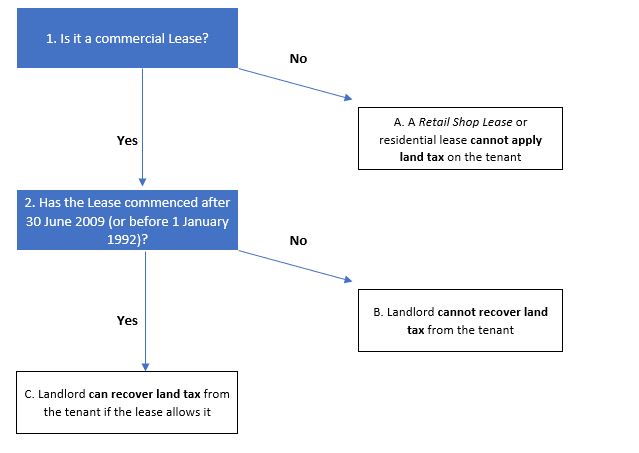
The following chart lists a simplified set of questions and outcomes for landlords and tenants to consider when looking at land tax.

A. Residential or Retail Leases

Tenants in a retail shop lease cannot be required to provide land tax by the landlord. While landlord’s outgoings can be recovered in retail shop leases, clause 7(3) of the Retail Shop Leases Act 1994 (Qld), specifies that land tax cannot be included as a recoverable outgoing.

In residential leases, the Lessor must pay all charges, levies, premiums, rates or taxes for the premises, which includes council rates and land taxes, per clause 163 of the Residential Tenancies and Rooming Accommodating Act 2008 (Qld).

B. Leases that commenced between 1 January 1992 to 30 June 2009.

Commercial leases that commenced during the period between 1 January 1992 and 30 June 2009 cannot recover land tax from the tenants, even if there are provisions in the lease that allows for it.

However, per the decision in Vikpro Pty Ltd v Wyuna Court Pty Ltd [2016] QCA 225 in leases that commenced during this period, with land tax arising on or after 30 June 2010 which has: –

  • already been paid by the tenant, then that amount can be retained by the landlord and the tenant cannot seek to recover the land tax already paid; or
  • been ordered by the court to be payable by the tenant, that order can still be enforced.
  • Leases after 30 June 2009

Since the decision in Vikpro Pty Ltd v Wyuna Court Pty Ltd and a legislative change in 2017, landlords in commercial leases that commence after 30 June 2009 will be able to recover land tax arising from 30 June 2010 onwards, as long as the lease permits it.

Potential tenants seeking to enter into a lease requiring contributions of outgoings, including land tax should ensure that they receive sufficient disclosures on the anticipated costs, including by seeking a land tax clearance search.

If you have any questions about a commercial lease and the recovery of land tax, please call us on (07) 3839 7555.

Common Estate Planning Traps to Avoid

As with most estate administration matters, we see clients that are left with difficult circumstances after their parent has passed away. Sometimes, those clients are survived by step parents, who were married to the deceased parent for only a short duration and had no biological children together.

Common issues that arise during the course of these matters, include: the deceased parent failing to leave a valid Will or failing to execute a valid binding death benefit nomination for payment of their superannuation death benefits. The clients are left to deal with these complicated issues, which can lead to disputes and causing legal and accounting fees to be unnecessarily incurred.

Steps can be taken during your lifetime to ensure that your family is safely provided for on your death. Below is a non-exhaustive list of common estate planning traps to avoid.

  1. Marriage (and civil partnership) revokes a Will

A Will is revoked by the marriage of the testator. If a testator enters into a civil partnership, their Will is also revoked.

However, if the Will contains gifts of property to the spouse of the deceased at the date of death (or other dispositions of property), or appoints the spouse as Executor (or as Trustee, Guardian or any other appointment), then the Will is not revoked to that extent. They may be left with the power to distribute assets to themselves which could be unintended.

To avoid this mistake, consider whether a Will should be made in contemplation of marriage. Generally, the solemnisation of the marriage will not revoke the Will.

  1. Divorce or annulment (or end of a civil partnership or de facto relationship) revokes a Will

If a testator’s marriage ends by divorced or is annulled, and their Will contains dispositions of property to the former spouse, or appointments of the former spouse, then these provisions are revoked.  For example, a gift of real property to a former spouse is revoked and the gift takes effect as if the former spouse had died before the testator.

There are some exceptions. For example, appointments of the former spouse as Trustee of property for minor children of their marriage, will not be revoked.

The effect of termination of a civil partnership or the ending of a de facto relationship on a Will, is the same as those effects for divorce or annulment.  

An important tip is to ensure a Divorce Order is obtained from the Family Court. Otherwise the former spouse is still considered a spouse of the testator.  

  1. Death Benefit Nominations

You can provide the Trustee of a Superannuation Fund with a death benefit nomination (which can be binding or non-binding) for payment of your death benefits. The death benefits can be paid to the legal personal representative (i.e. Executor or Administrator) or a dependant or dependants of the member.

The legislation provides a nomination ceases to have effect three years after the day it was first signed by the member. If the nominations lapses, it may be deemed non-binding and the trustee has discretion to pay the death benefits as it sees fit.

If a member struggles to remember to renew their death benefit nomination, consider rolling the funds into a Self-Managed Superannuation Fund, which enables a member to make a non-lapsing and binding nomination (provided the trust deed expressly allows it). Accounting and tax advice should be obtained to consider whether a Self-Managed Superannuation Fund is suitable for individual circumstances.

  1. Tenants in Common and Joint Tenants

When purchasing real or personal property with one or more persons (or entities), you will need to consider the form of ownership.

An important factor to consider is whether to hold property as “tenants in common” or “joint tenants”. Tenants in common hold their interest in the property separately. Their interest is registered on title as a fraction of ownership.

This means that on the death of one of the tenants, their interest in the property forms part of their estate and is distributed in accordance with their Will.

If property is held as joint tenants, then on the death of a joint tenant, their interest vests automatically in the surviving joint tenant. Their interest will not form part of their estate on death. This is not often discussed during a conveyance and can have devastating effects at the time of death.

Holding property as tenants in common can mean that beneficiaries will need to commit to owning property with another person (or entity), which may be a partnership if it is a commercial or residential investment property.

If the circumstances do not allow for those beneficiaries to receive the cash equivalent of the deceased’s interest in that property, they will end up holding the deceased’s share in the property, proportional to their share of the estate.

If you would like to plan your Will and avoid these and other devastating estate planning traps, please do not hesitate to call Tony Crilly or Elizabeth Ulrick on 07 3839 7555 or email us brisbane@perspectivelaw.com.

If you want 24/7 answers, please go to our website and click on the section “Start your estate planning now”.

If you have an estate to discuss, please click on the link “Start your estate administration now”.